
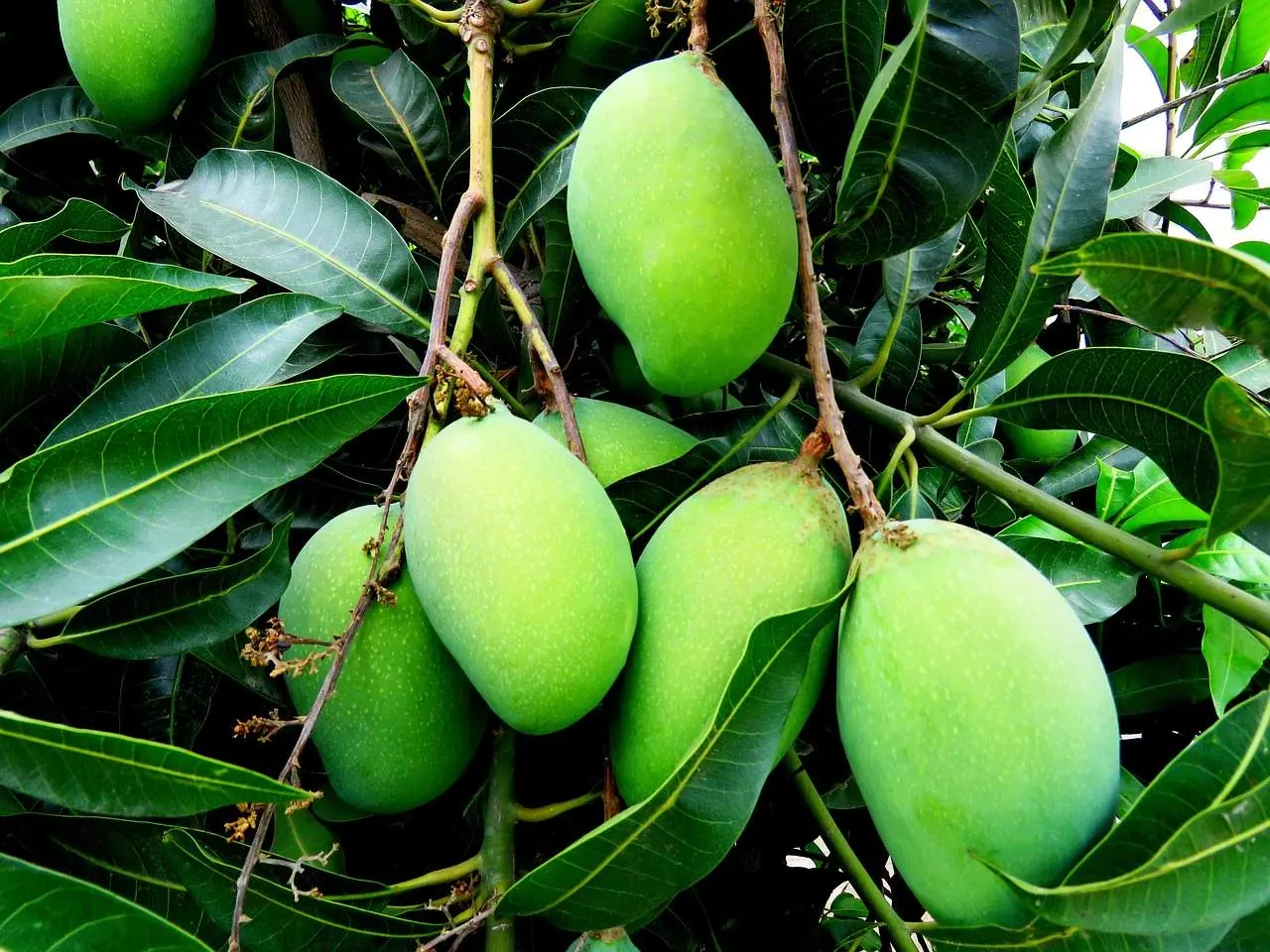
Wondering how to grow mango tree fruit where winters can bite? Choose a warm, sheltered spot, plant a grafted named variety, and prune it to a size you can reach. Climate matters most.
This guide is one part of the wider subject of tropical fruit trees for home gardens.
| Item | Value |
|---|---|
| Mature tree cold tolerance | 25 degrees F for a few hours, with only minor injury |
| Young tree cold tolerance | 29 to 30 degrees F |
| Flowers and fruit | Cannot withstand below 40 degrees F for too long |
| First fruit from a grafted tree | As little as 3 to 5 years |
| Flowering to mature fruit | Up to 150 days |
| Height to aim for when pruning | Around 12 feet |
These figures come from the UF/IFAS Extension Charlotte County mango post, which describes Florida conditions. Figures can change and local conditions differ, so check the source before you rely on them.
Why climate decides whether a mango tree thrives
The UF/IFAS Extension post calls climate perhaps the most important consideration when choosing to plant a mango. Mature trees can survive 25 degrees F for a few hours with only minor injury, while younger trees can take only 29 to 30 degrees F, according to the Extension post.
Flowers and fruit are less forgiving, since they cannot withstand temperatures below 40 degrees F for too long. Because mangoes flower from December to April, cold nights in that window deserve attention, as the same source notes.
The author’s best bet for long-term success is an area relatively close to the water. Natural microclimates, meaning protected spots that run warmer than normal, can also suit a mango. Tolerance for cold improves a little as trees mature, but a harsher freeze than usual may still arrive some winter.
If your winters sit on the borderline, the guide to overwintering tropical fruit trees is a useful next read.
Which mango varieties suit a home garden?
Taste differs from one variety to the next, so the post suggests trying the fruit of a named variety in season to find the flavor and texture you like best. It lists these as good choices for home culture, available at most local garden centers:
- ‘Haden’, with reddish-yellow skin
- ‘Carrie’ and ‘Saigon’, with greenish-yellow skin
- ‘Edward’ and ‘Glenn’, with pinkish, reddish-yellow skin
- ‘Kent’, with greenish, reddish-yellow skin, and ‘Keitt’, with greenish, pinkish-yellow skin, which are also recommended
People have cultivated mangoes for over four thousand years, and the tree also makes an attractive evergreen landscape plant, says the UF/IFAS post. Grafted trees will begin to produce in as little as 3 to 5 years, so patience is part of the plan.
Spacing, size and pruning
Left alone, a mango tree grows medium to large, at 30 feet tall and higher. The UF/IFAS post says it can and should be pruned for ease of harvest and maintenance.
Annual selective pruning can be done right after harvest, working to keep the tree around 12 feet tall. Trees held at that size can be planted 12 to 15 feet apart and away from buildings.
Watering and feeding
The advice on watering is simple: water well during establishment, during drought and while the tree is fruiting.
For feeding, the Extension post gives this schedule:
- First year: fertilize about every 3 months after planting.
- After the first year: fertilize twice a year.
- Product: any commercially available granular tropical fruit fertilizer that contains micronutrients.
Mangoes will also benefit from foliar micronutrient sprays. Keep in mind that this material can stain cement and stonework, and always read the label for application amounts and timing.
Flowering, fruit and harvest timing
In the Florida setting described by the Extension post, mangoes flower from December to April, and mature fruit is ready to eat from May to September. It can take up to 150 days from flowering until the fruit is mature.
Most of the local harvest falls in June and July. Your own harvest window will depend on your climate and variety, so treat these months as one example rather than a rule.
Planning a mixed planting? Gardeners who want a faster-growing companion crop can read how to grow papaya as well.
Protecting a mango tree from disease and animals
The fungal disease anthracnose is perhaps the most common pest problem, according to the UF/IFAS post. It can show up in several ways:
- Spots on flowers, leaves and stems
- Streaks on the same plant parts
- Rot on the fruit
The disease can be controlled with copper fungicide used as per label directions. Squirrels or raccoons sometimes damage fruit, and netting or chicken wire can protect it.
Frequently asked questions
How cold is too cold for a young mango tree?
Show answer
Young trees have a narrow margin: the UF/IFAS post gives 29 to 30 degrees F as the lowest they can take. Older trees cope better, so a young tree is the one to shelter first.
How long until a mango tree gives fruit?
Show answer
A grafted tree may begin producing in as little as 3 to 5 years, according to the Extension post. Once a flower opens, the fruit needs up to 150 days to mature.
Can I keep a mango tree small?
Show answer
Yes, the source recommends annual selective pruning right after harvest to hold the tree near 12 feet, rather than letting it reach 30 feet or more. Details are in the UF/IFAS post.
What is the most common mango problem?
Show answer
Anthracnose, a fungal disease, is named as perhaps the most common pest problem. Copper fungicide is the control mentioned, used strictly according to its label.