
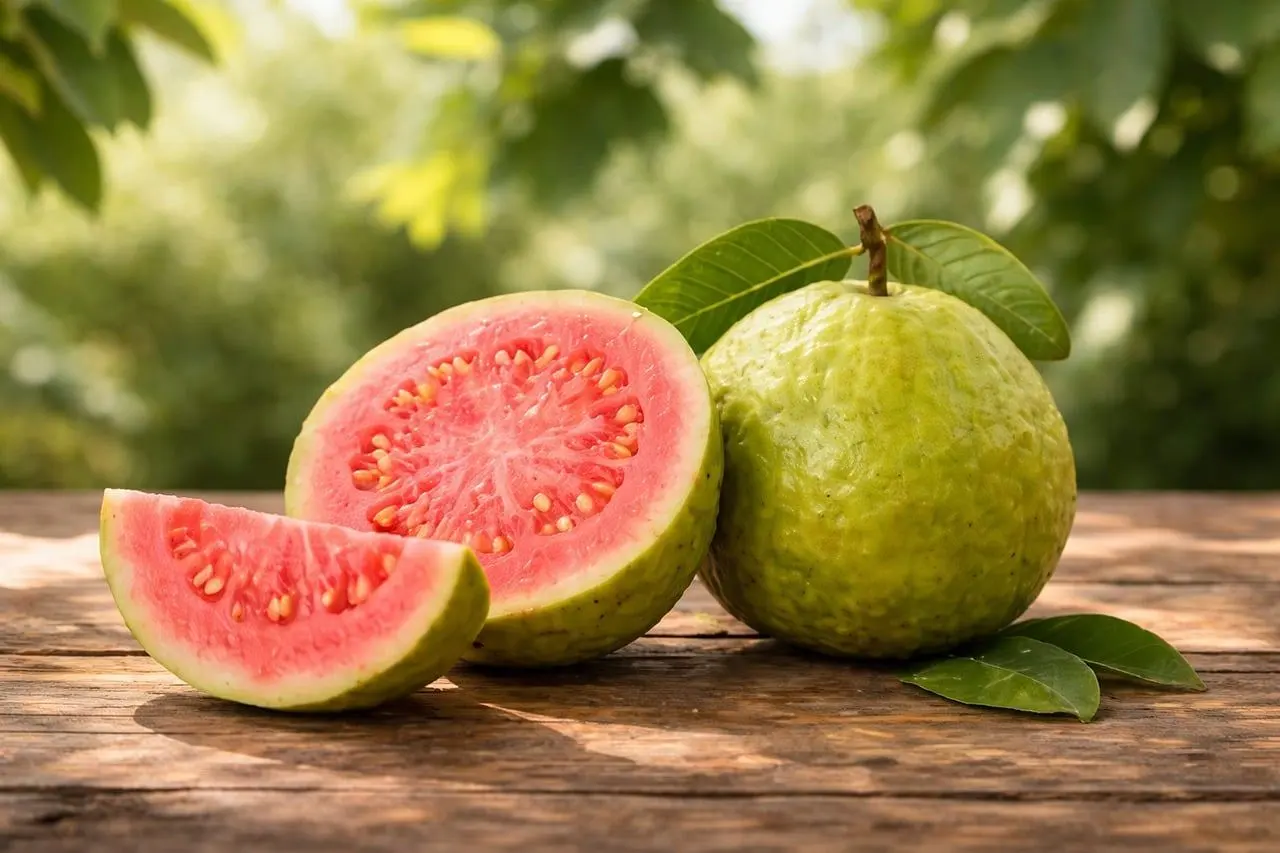
Unsure how to eat guava, seeds and all? Cut it open and eat the flesh fresh, or strain out the seeds for a smooth purée, jam or juice.
For more ideas beyond fresh fruit, browse the full set of guava recipes.
| Item | Value |
|---|---|
| Flesh colours | White, yellow, pink or red |
| Seed length | About 3-5 mm |
| Heaviest fruit | Up to 500 g |
| Shelf life at 5°C and 75-85% relative humidity | Up to 20 days |
| Room-temperature storage in ventilated plastic bags (India) | 10 days |
These figures come from PlantVillage (Penn State) and Feedipedia. Figures can change, so check the source before you rely on them.
How can you tell a guava is ready to eat?
Start with the fruit itself. According to PlantVillage, guava does not ripen off the tree, and it can be hard to tell when a fruit is ready. The best indication it gives is a colour change from dark to light green, with some yellowing.
That guidance is written for harvest, but it is a sensible cue at the market too. Feedipedia describes the skin as yellowish to orange and calls the fruit highly perishable, so carry it home gently.
Cutting guava step by step
You need only a knife, a spoon and a board. These steps suit a whole fruit eaten fresh.
- Rinse the fruit under cool running water and pat it dry.
- Set it on the board and cut it in half through the middle.
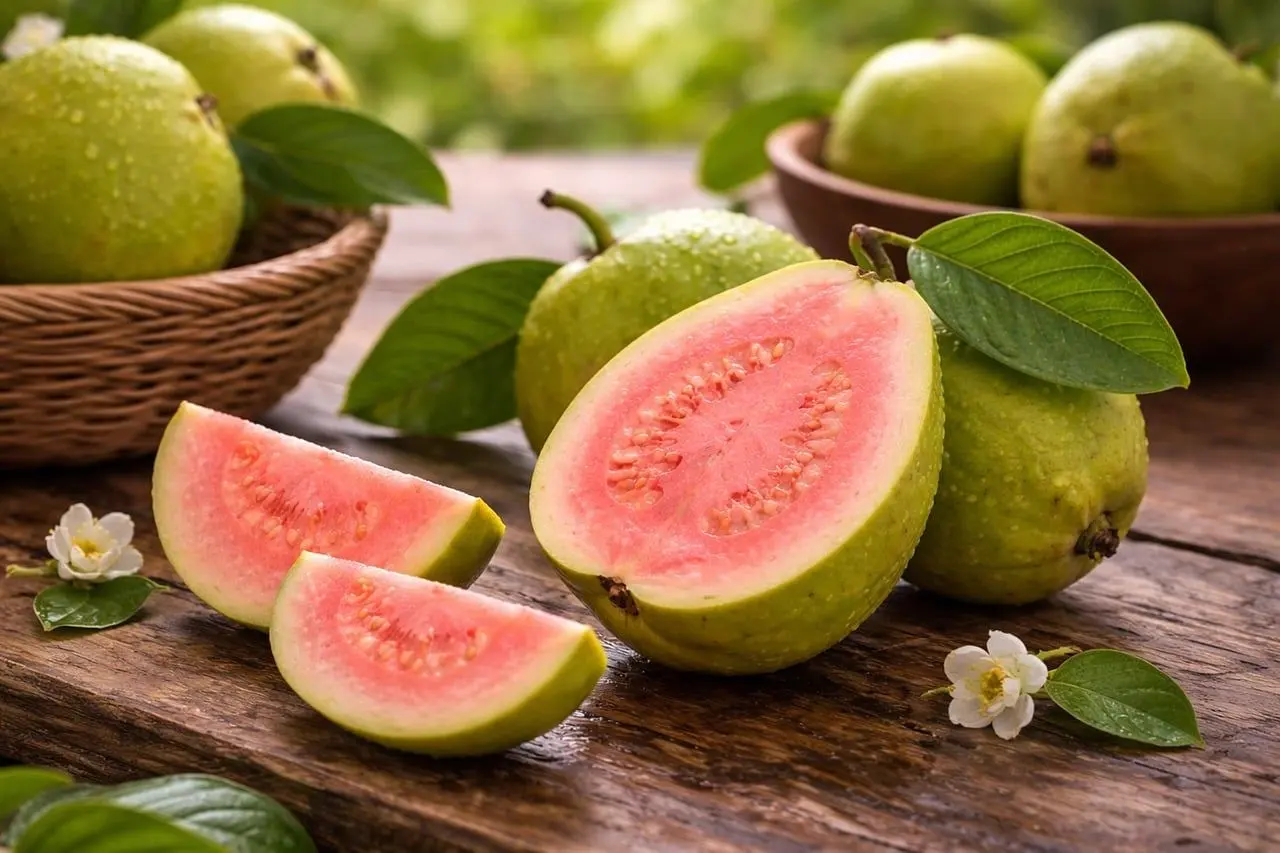
- Look at the flesh, which can be white, yellow, pink or red.
- Scoop the flesh out with a spoon, or slice each half into wedges.
- Decide what to do with the seeds, as covered in the next section.
Size varies a lot. Feedipedia says a single berry can weigh up to 500 g, so a large one may be enough to share. The colour range of the flesh is also listed by PlantVillage, which is why two guavas can look so different once cut.
Peel, seeds and fibre: what to do
Peeling is a matter of preference. The sources behind this guide say guava is eaten raw but do not address the skin, so try a small piece first and decide from there.
Inside, the flesh holds numerous yellowish seeds, and Feedipedia gives their length as about 3-5 mm. Your options are to leave them in, scoop them out with a spoon, or strain them away.
The flesh also contains small, hard, fibrous structures called stone cells. For purée, producers chop the fruit and run it through a pulper that removes seeds and fibrous tissue, then through a finisher that removes the stone cells.
At home, a fine sieve and the back of a spoon follow the same logic. The result is a smooth pulp you can stir into drinks, sauces or fillings.
Serving ideas beyond eating it raw
Feedipedia says guava is mainly grown for fruit that is eaten raw or made into purée, jam, jelly, paste, juice, syrup and chutney. PlantVillage adds preserves and, from dehydrated fruit, guava powder.
- Fresh halves or wedges, eaten straight from the board.
- Strained purée or pulp for drinks, sauces and syrups.
- Jam, jelly and preserves for spreading.
- Paste, a processed form that keeps the flavour concentrated.
- Chutney, for a savoury side.
- Dried fruit, which is also used to make guava powder.
For a baked take, see the guava pastry recipe.
Keeping guava fresh until you eat it
Ripe fruit is best used soon. Feedipedia says fully ripe guavas should be processed quickly but can be held longer in cool storage, and it reports a shelf life of up to 20 days at 5°C and 75-85% relative humidity.
The same Feedipedia datasheet notes that in India, ventilated plastic bags allow storage at room temperature for 10 days. For practical steps at home, see this guide on how to store guava.
Frequently asked questions
Can you eat guava seeds?
Show answer
The sources used here describe the seeds as numerous and note that commercial purée makers remove them. They do not say to avoid them, so leaving them in or straining them out comes down to your taste and the dish.
Does guava taste sweet or sour?
Show answer
Both are possible. Feedipedia describes the flesh as ranging from sour to sweet, and as juicy and aromatic.
Should guava go in the refrigerator?
Show answer
Cool storage is the route the datasheet gives for holding fruit longer, paired with fairly high humidity. Whole, cut and fully ripe fruit are not separated in that source, so treat it as a general guide.
Can you cook with guava?
Show answer
Yes. Producers turn it into preserves and sweet or savoury condiments, and dried fruit becomes powder, according to PlantVillage.